

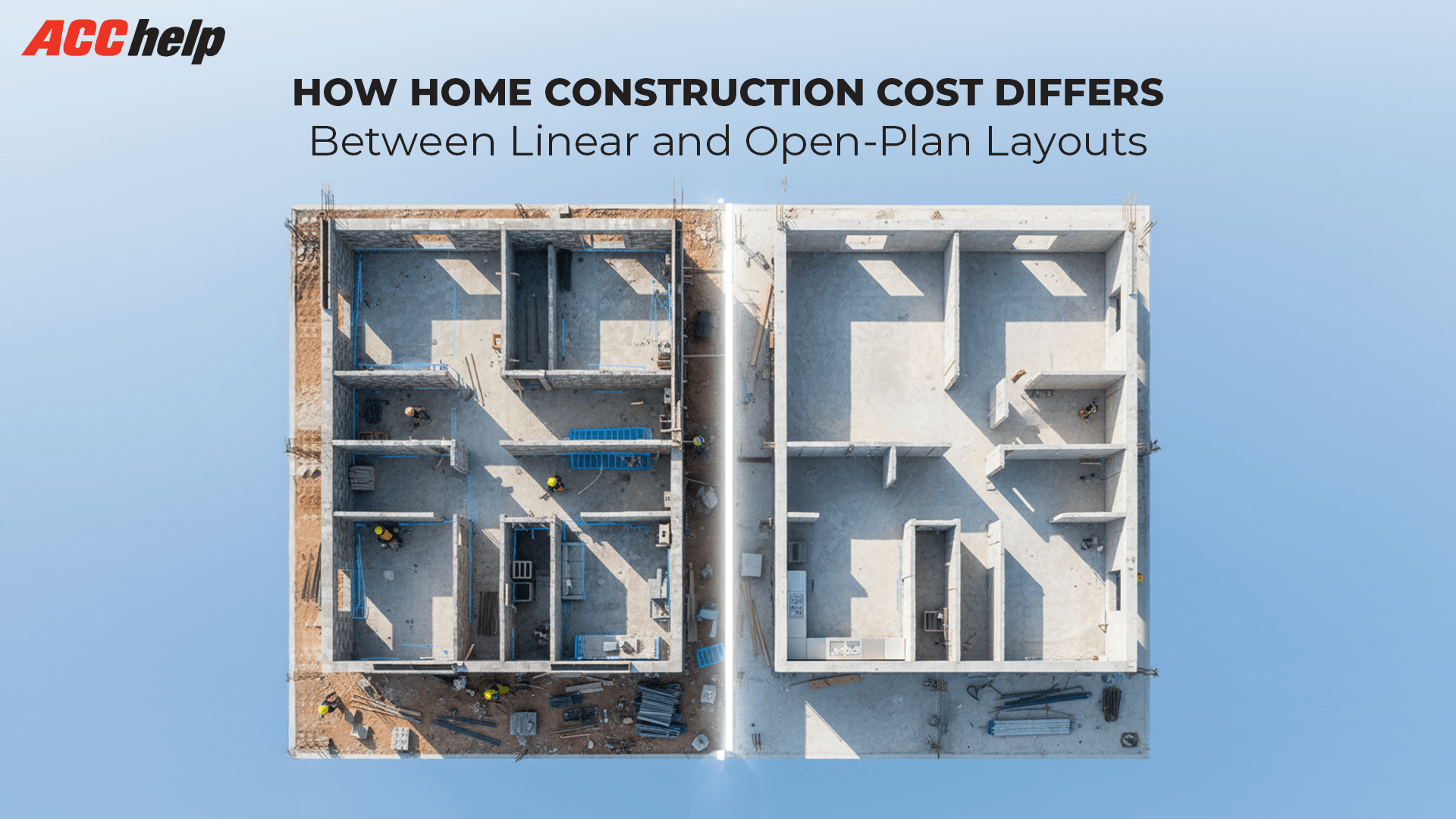
You probably first imagine the finishes, the kitchen style, or the flooring when thinking about the majority chunks of your home’s construction budget. But did you know that the layout itself can significantly affect your total Home construction cost? The way rooms are arranged, the number of walls, structural requirements, and even ventilation planning all influence how much you spend during construction and later on maintenance.
Two of the most common layout approaches today are linear (traditional) and open-plan designs. Both create very different living experiences, and both impact cost in different ways.
Let’s take a closer look at how each layout works and why their costs vary.
What Is a Linear (Traditional) Layout?
A linear or traditional layout divides the home into separate rooms using internal walls and doors. The living room, dining room, bedrooms, kitchen, and utility areas are clearly separated.
Key characteristics
- Defined rooms and fixed functional zones
- Solid internal walls and partitions
- Better noise control and privacy
- Supports traditional living setups, especially in joint families
Where it works best
- Larger homes or multi-storey houses
- Homes with multiple family members or elderly residents
- Locations with extreme climate where temperature control is needed
What Is an Open-Plan Layout?
An open-plan layout reduces internal walls and merges major areas, such as the living, dining, and kitchen areas, into one continuous space.
Key characteristics
- Minimum interior walls
- Large multi-purpose central zone
- Increased natural light and ventilation
- Flexible interior design possibilities
Where it works best
- Compact homes or modern urban apartments
- Homes for young couples or small families
- Spaces where social and interactive living is a priority
How Construction Cost Differs Between the Two Layouts
Due to the differences in both the structures, the cost of construction varies. Here are the major cost-impacting differences:
1. Structural Design Requirements
Linear Layout
- Needs more internal masonry walls for support
- More materials like bricks, blocks, plaster, and paint
- Lower steel and concrete requirement compared to framed open plans
Open-Plan Layout
- Needs stronger beams, columns, and reinforced structures because internal walls are reduced
- Higher cost for steel, cement, RCC framing, and engineering planning
- May require more ready-mix concrete for slab uniformity
Effect on Construction Cost:
Open plans may cost more structurally due to heavy-duty framing needs. You can use an online construction material calculator to help you estimate the costs of both, a load bearing structure as well as an RCC frame structure.
2. Material Consumption
Linear Layout
- More bricks or concrete blocks
- More plastering and finishing work
- Higher labour due to more partition construction
Open-Plan Layout
- Fewer bricks and partitions
- Lower plastering and painting area
- Higher reliance on structural materials instead
Effect on Cost:
Traditional layouts may cost more in finishing materials, while open layouts may cost more structurally.
3. Electrical, Plumbing, and HVAC Planning
Linear
- Smaller enclosed spaces are easier to cool or heat
- More wiring and ducting due to divided walls
Open-Plan
- Larger areas require higher-capacity ACs or multiple units
- More cost on concealed electrical layouts
Effect on Cost:
Open plans can increase long-term energy cost but reduce wall-based electrical work.
4. Time and Labour
Linear
- More time-consuming due to detailed room-wise workmanship
Open-Plan
- Faster construction with fewer walls, but more structural precision needed
5. Finishing and Interior Costs
Linear
- More doors, more windows, more hardware
- More defined opportunities to hide clutter
Open-Plan
- Minimalist finish demands higher-quality detailing for aesthetic consistency
Where a House Cost Estimator Helps
A house cost estimator allows you to:
- Compare estimated construction cost for both layout styles
- Calculate material and labour variations
- Understand long-term maintenance impacts
By comparing side-by-side estimates before starting, homeowners can choose the most cost-effective option for their needs and location.
Which Layout Is More Affordable?
There is no universal “cheaper” option. It depends on:
- Region-wise material prices
- Climate and ventilation needs
- Family size and lifestyle
- Architectural design complexity
In general
|
Layout Type |
May Cost More Because |
Long-Term Expense |
|
Linear |
More walls, finishing, doors, labour |
Lower cooling costs and better privacy |
|
Open-Plan |
Stronger beams and framing, HVAC capacity |
Higher energy use in large open spaces |
For many homes today, hybrid layouts are also popular, where public areas are open but private areas like bedrooms have partitions.
Final Thoughts
Choosing between linear and open layouts is not just a design preference. It directly influences:
- Construction budget
- Material selection
- Energy usage
- Maintenance and renovation potential
Using a house cost estimator before finalising your blueprint gives a clearer picture of cost differences and helps you build more confidently.
If you want a home that adapts to your lifestyle and future needs, compare both layout types early and choose what fits your family’s living style best.

 COMMENT
 FACBOOK


Comments (0)