

The global Functional Safety Market is witnessing significant growth as industries increasingly focus on operational safety, risk management, regulatory compliance, and system reliability. Rapid industrial automation, rising adoption of smart manufacturing technologies, and increasing concerns regarding workplace safety are driving the demand for advanced functional safety solutions worldwide.
Functional safety refers to systems and technologies designed to reduce risks caused by equipment failures, human errors, software malfunctions, or hazardous operational conditions. These systems help ensure that industrial processes operate safely even during unexpected failures or abnormal conditions. Functional safety solutions are widely used in industries such as oil & gas, automotive, manufacturing, power generation, pharmaceuticals, transportation, chemicals, and mining.
As industrial environments become more automated and interconnected, the importance of reliable safety systems continues to increase. Organizations are investing heavily in functional safety technologies to prevent accidents, minimize operational downtime, improve equipment performance, and comply with strict international safety regulations.
The growing adoption of Industry 4.0 technologies, industrial Internet of Things (IIoT), robotics, and artificial intelligence is further accelerating the expansion of the Functional Safety Market globally.
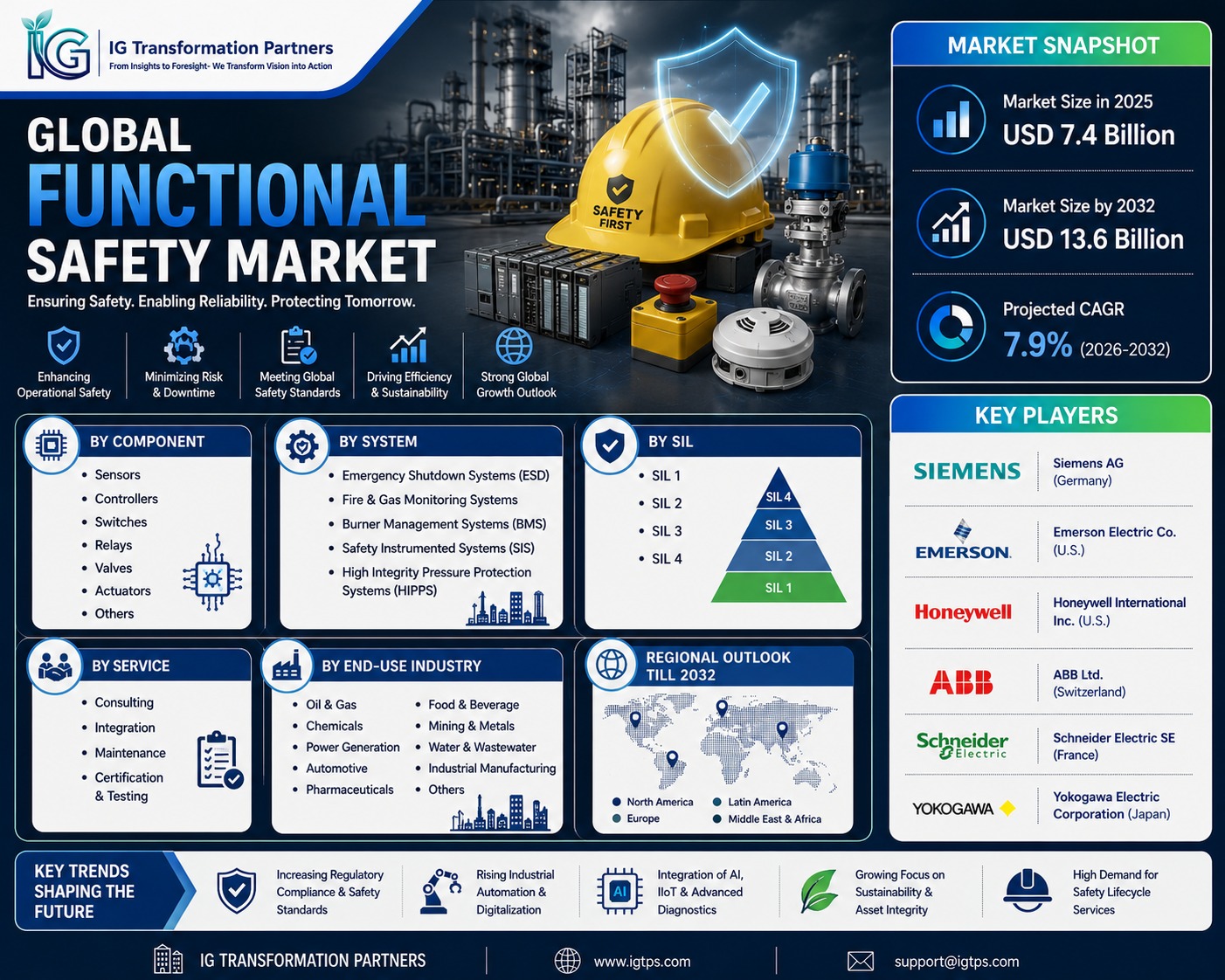
Understanding the Functional Safety Market
Functional safety involves the implementation of automatic protection systems that detect potentially dangerous conditions and take corrective actions to maintain safe operations. These systems are designed to minimize risks associated with industrial equipment, machinery, control systems, and manufacturing processes.
Functional safety solutions include safety sensors, emergency shutdown systems, programmable safety controllers, safety relays, safety switches, fire and gas monitoring systems, pressure protection systems, and industrial safety software. These technologies work together to ensure that industrial systems respond safely during operational failures or hazardous situations.
The market is heavily influenced by international safety standards such as IEC 61508, ISO 26262, IEC 62061, and IEC 61511, which establish safety requirements for industrial systems and automotive applications. Compliance with these standards has become essential for organizations operating in highly regulated industries.
As companies prioritize employee safety, environmental protection, and operational continuity, the demand for functional safety systems continues to rise across multiple industrial sectors.
Rising Industrial Automation Driving Market Growth
One of the primary growth drivers of the Functional Safety Market is the rapid expansion of industrial automation worldwide. Modern manufacturing facilities increasingly rely on automated machinery, robotics, and intelligent process control systems to improve efficiency and productivity.
However, increased automation also creates greater operational complexity and higher safety risks. Equipment failures, software errors, or process malfunctions in automated environments can lead to serious accidents, financial losses, and production disruptions.
Functional safety systems help industries reduce these risks by enabling automatic fault detection, emergency shutdown procedures, and safe operational responses. These technologies play a critical role in protecting workers, equipment, and industrial infrastructure.
Industries such as automotive manufacturing, oil & gas processing, chemical production, and energy generation are investing heavily in functional safety solutions to maintain safe and reliable operations in highly automated environments.
Growing Importance of Workplace Safety and Regulatory Compliance
Governments and regulatory agencies across the world are implementing stricter workplace safety regulations to reduce industrial accidents and improve employee protection. As a result, companies are increasingly required to comply with international safety standards and operational risk management frameworks.
Functional safety systems help organizations meet regulatory requirements by improving process safety, reducing operational hazards, and maintaining safe working conditions. Compliance with global standards not only improves worker protection but also helps organizations avoid legal penalties, operational shutdowns, and reputational damage.
Industries handling hazardous materials, high-pressure systems, flammable chemicals, or complex machinery are particularly dependent on advanced safety systems. Functional safety technologies are becoming essential for maintaining operational integrity in these high-risk industrial environments.
The growing emphasis on occupational health and safety is expected to continue driving strong market demand in the coming years.
Technological Advancements Transforming the Market
Technological innovation is significantly reshaping the Functional Safety Market. The integration of artificial intelligence, machine learning, predictive analytics, cloud computing, and industrial IoT technologies is improving the efficiency and intelligence of modern safety systems.
AI-powered safety platforms can monitor industrial operations in real time, identify abnormal equipment behavior, predict potential failures, and automatically trigger safety responses before accidents occur. Predictive maintenance technologies are helping industries reduce unexpected equipment breakdowns and improve operational reliability.
Industrial IoT sensors and connected safety devices allow organizations to collect real-time operational data from machinery, production lines, and industrial control systems. This enables continuous safety monitoring and faster incident response.
Cloud-based safety management platforms are also gaining popularity as they provide centralized monitoring, remote diagnostics, and advanced reporting capabilities. These technologies improve decision-making while enhancing operational visibility across industrial facilities.
In addition, digital twins and simulation technologies are helping companies test safety scenarios, evaluate risk conditions, and optimize industrial safety strategies before implementing them in real-world environments.
Market Segmentation Analysis
The Functional Safety Market can be segmented based on component, system type, industry vertical, and application area. Different industries adopt functional safety solutions depending on their operational requirements, risk exposure, and regulatory obligations.
Safety sensors, programmable safety systems, emergency shutdown systems, safety relays, and fire & gas monitoring systems represent major product categories within the market. Among these, programmable safety systems are witnessing strong demand due to increasing industrial automation and smart manufacturing adoption.
From an industry perspective, the oil & gas sector remains one of the largest users of functional safety systems because of the high-risk nature of exploration, refining, and transportation operations. The automotive industry is also experiencing significant growth due to increasing demand for advanced driver assistance systems (ADAS), autonomous vehicles, and electric vehicle safety technologies.
Manufacturing, power generation, pharmaceuticals, mining, transportation, and chemical industries are also major contributors to market expansion as they continue modernizing industrial safety infrastructure.
Regional Market Insights
North America currently holds a significant share of the Functional Safety Market due to advanced industrial infrastructure, strong regulatory frameworks, and widespread adoption of industrial automation technologies. The United States remains a key market because of its large manufacturing base and growing investments in industrial cybersecurity and operational safety.
Europe is another major market driven by strict workplace safety regulations, advanced manufacturing capabilities, and increasing focus on Industry 4.0 adoption. Countries such as Germany, the United Kingdom, and France are heavily investing in smart factory technologies and industrial safety systems.
The Asia-Pacific region is expected to witness the fastest growth during the forecast period due to rapid industrialization, expanding manufacturing sectors, and rising infrastructure investments. Countries including China, India, Japan, and South Korea are increasingly adopting automation technologies and advanced safety systems across industrial operations.
The Middle East and Latin America are also experiencing growing demand for functional safety solutions, particularly in oil & gas, mining, and energy-related industries.
Challenges in the Functional Safety Market
Despite strong growth opportunities, the Functional Safety Market faces several challenges. One of the major challenges is the high implementation cost associated with advanced safety systems. Many organizations, especially small and medium-sized enterprises, face difficulties investing in complex functional safety infrastructure.
The integration of safety systems into existing industrial environments can also be technically challenging and time-consuming. Legacy industrial systems often require significant upgrades and customization to support modern safety technologies.
Another important challenge is the shortage of skilled professionals with expertise in industrial safety engineering, risk analysis, and safety system management. Organizations require trained personnel to design, implement, and maintain functional safety systems effectively.
Cybersecurity risks are also becoming increasingly important as industrial safety systems become more connected through digital networks and IoT platforms. Protecting safety-critical infrastructure from cyber threats has become a major industry priority.
Emerging Opportunities in the Functional Safety Market
The rapid growth of smart factories and Industry 4.0 technologies is creating significant opportunities for the Functional Safety Market. Manufacturers are increasingly investing in intelligent automation systems that combine operational efficiency with advanced safety management capabilities.
The growing electric vehicle market is also creating new opportunities for functional safety technologies. Electric vehicles and autonomous driving systems require highly reliable safety mechanisms to ensure vehicle stability, passenger protection, and operational reliability.
Renewable energy projects, including wind farms, solar power plants, and energy storage systems, are increasingly adopting functional safety systems to improve infrastructure reliability and reduce operational risks.
In addition, the expansion of industrial robotics and collaborative robots is increasing the need for advanced machine safety systems capable of supporting safe human-machine interaction in automated environments.
As digital transformation continues accelerating globally, demand for intelligent, connected, and predictive safety systems is expected to rise significantly.
Role of IG Transformation Partners in Market Intelligence
As industrial automation and safety technologies evolve rapidly, businesses require accurate market intelligence and strategic insights to remain competitive. IG Transformation Partners supports organizations with comprehensive market research, technology analysis, industry forecasting, competitive intelligence, and strategic consulting within the Functional Safety Market.
Detailed market insights help companies identify emerging trends, evaluate investment opportunities, improve operational strategies, and adapt to changing industrial safety requirements in a highly competitive global environment.
Future Outlook of the Functional Safety Market
The future of the Functional Safety Market appears highly promising as industries continue prioritizing workplace safety, operational efficiency, and automation reliability. The increasing adoption of artificial intelligence, industrial IoT, predictive maintenance technologies, and smart manufacturing systems is expected to drive significant market growth over the coming years.
Organizations across industries are likely to increase investments in intelligent safety systems capable of real-time monitoring, predictive analysis, and automated risk management. Regulatory pressures and rising awareness regarding industrial safety will further support market expansion globally.
The growth of autonomous systems, connected industrial infrastructure, electric mobility, and digital manufacturing will continue creating new opportunities for functional safety solution providers. In addition, ongoing advancements in cybersecurity, cloud computing, and data analytics will improve the performance and scalability of next-generation safety systems.
As industrial operations become increasingly interconnected and automated, functional safety technologies will play a critical role in ensuring safe, efficient, and sustainable industrial environments worldwide.
Conclusion
The Functional Safety Market is becoming an essential part of modern industrial operations as organizations focus on reducing operational risks, improving workplace safety, and maintaining regulatory compliance. Rising industrial automation, increasing safety awareness, and rapid technological advancements are driving strong global demand for functional safety solutions.
Technologies such as artificial intelligence, industrial IoT, predictive analytics, and cloud-based safety platforms are transforming industrial safety management and improving operational reliability. At the same time, industries are increasingly investing in intelligent safety systems to support smart manufacturing and digital transformation initiatives.
As the global industrial landscape continues evolving, companies investing in advanced safety technologies, automation infrastructure, and cybersecurity solutions are expected to gain significant competitive advantages in the rapidly expanding Functional Safety Market.
For detailed market insights, forecasts, trends, and strategic analysis, explore the full report here:
https://www.igtps.com/report/functional-safety-market
FAQs
1. What is the Functional Safety Market?
The Functional Safety Market involves technologies and systems designed to minimize industrial risks and ensure safe operation during equipment failures or hazardous situations.
2. Why is functional safety important in industries?
Functional safety helps prevent accidents, protect workers, reduce operational downtime, and maintain compliance with international safety regulations.
3. Which industries commonly use functional safety systems?
Industries such as oil & gas, automotive, manufacturing, chemicals, power generation, mining, and pharmaceuticals widely use functional safety technologies.
4. How is artificial intelligence impacting the market?
AI improves real-time monitoring, predictive maintenance, fault detection, and automated risk management in industrial safety systems.
5. Which region currently dominates the market?
North America currently leads the market due to advanced industrial infrastructure and strong workplace safety regulations.
6. What are the major challenges in the market?
Key challenges include high implementation costs, integration complexity, cybersecurity concerns, and shortage of skilled professionals.
7. What is the future outlook for the Functional Safety Market?
The market is expected to grow significantly due to increasing industrial automation, Industry 4.0 adoption, smart manufacturing expansion, and rising safety compliance requirements.

 COMMENT
 FACBOOK


Comments (0)