

The pharmaceutical industry is undergoing a major transformation as artificial intelligence (AI) becomes increasingly integrated into drug research and development. From identifying promising drug targets to optimizing lead compounds and accelerating preclinical research, AI is helping pharmaceutical and biotechnology companies improve efficiency, reduce development timelines, and enhance decision-making.
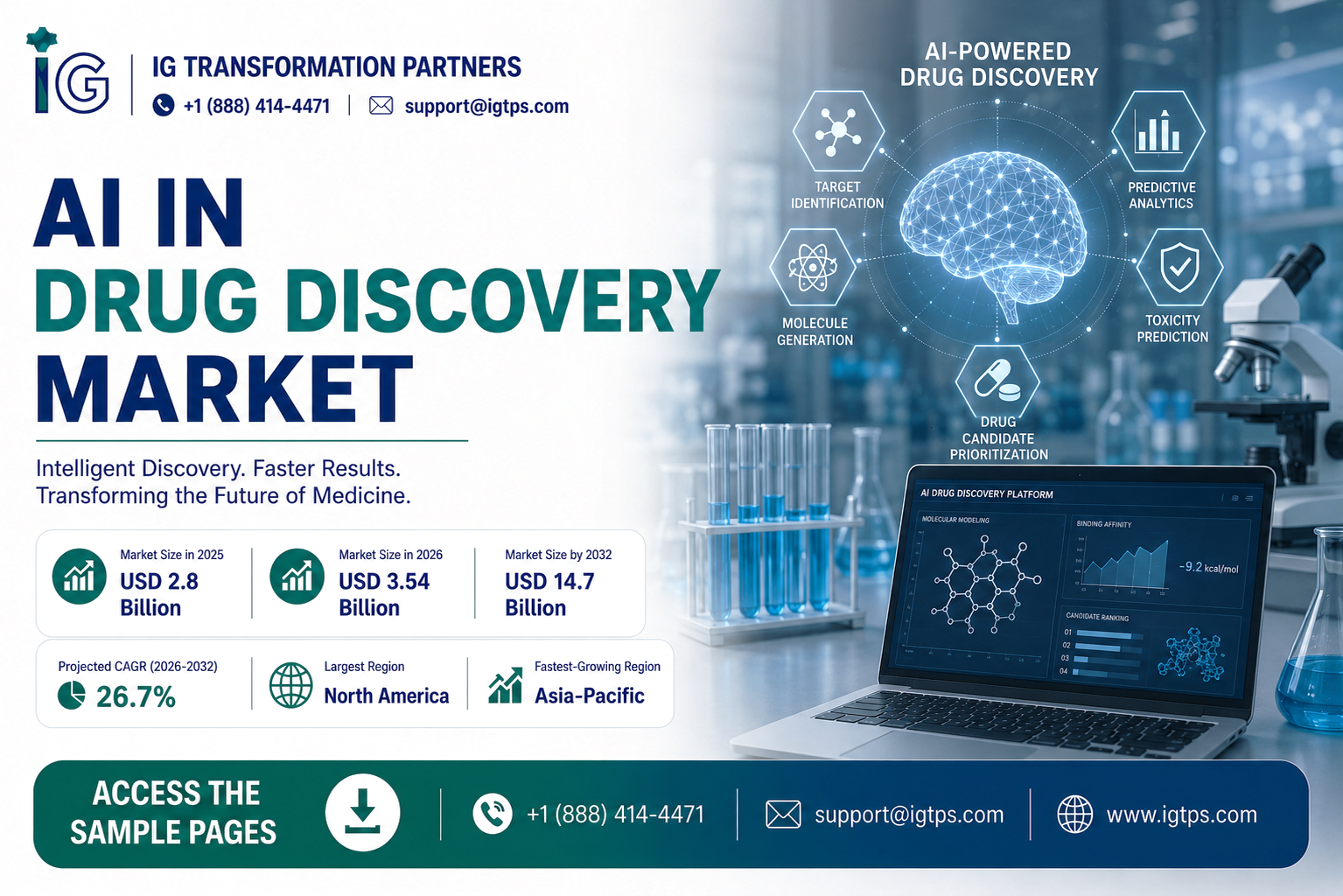
The global AI in Drug Discovery Market is projected to expand significantly, reaching USD 14.7 billion by 2032, up from USD 3.54 billion in 2026. The market is expected to grow at a remarkable 26.7% CAGR from 2026 to 2032, supported by increasing investments in AI technologies, growing pharmaceutical R&D activities, and the rising adoption of data-driven approaches across the drug discovery workflow.
AI in Drug Discovery Market Overview
The AI in Drug Discovery Market is gaining momentum as pharmaceutical companies, biotechnology firms, contract research organizations (CROs), and academic institutions increasingly adopt artificial intelligence to address complex challenges in drug development.
Traditional drug discovery is often a lengthy and expensive process involving target identification, compound screening, lead optimization, and preclinical evaluation. AI-based solutions can analyze large and complex datasets, identify patterns, predict molecular interactions, and support researchers in prioritizing promising candidates.
The growing application of Artificial Intelligence in Drug Discovery is creating new opportunities to accelerate research while potentially improving the probability of identifying viable drug candidates. As computational capabilities continue to advance, AI is becoming an important component of modern pharmaceutical research.
Market to Witness Rapid Growth Through 2032
The market is expected to demonstrate strong growth during the forecast period. The AI Drug Discovery Market Size is estimated at USD 2.8 billion in 2025 and is projected to reach USD 3.54 billion in 2026. By 2032, the market is forecast to reach USD 14.7 billion, representing a 26.7% CAGR between 2026 and 2032.
This rapid expansion reflects the increasing demand for advanced computational tools that can support researchers throughout the drug development process. Pharmaceutical and biotechnology companies are investing in AI platforms to improve research productivity and identify potential drug candidates more efficiently.
The increasing availability of high-quality biological data, advances in machine learning, and improvements in cloud computing are also contributing to the expansion of the AI Drug Discovery Technology ecosystem.
Machine Learning and Generative AI Drive Innovation
Among the key technologies shaping AI in Pharmaceutical Research, machine learning and generative AI are attracting significant attention.
Machine Learning in Drug Discovery can be applied to analyze molecular structures, predict drug-target interactions, identify potential biomarkers, and support compound prioritization. These capabilities can help researchers process large datasets and make more informed decisions during early-stage drug discovery.
At the same time, Generative AI in Drug Discovery is emerging as a transformative technology. Generative models can assist researchers in designing novel molecular structures with desired properties, potentially opening new pathways for developing innovative therapeutic candidates.
Other technologies, including natural language processing (NLP) and computer vision, are also expanding the capabilities of AI-based drug discovery platforms. NLP can help researchers extract insights from scientific publications and clinical data, while computer vision can support image-based analysis in areas such as cellular research and pathology.
Key Drug Discovery Workflows Supported by AI
The application of AI extends across multiple stages of the drug discovery process. Key workflows include:
- Target Identification & Validation: AI can help researchers analyze biological data to identify potential disease targets and assess their relevance.
- Hit Identification: AI-based approaches can support virtual screening and help identify promising compounds for further investigation.
- Lead Optimization: Machine learning models can assist in predicting molecular properties and optimizing potential drug candidates.
- Preclinical Candidate Selection: AI tools can support the evaluation and prioritization of candidates before they move into advanced development stages.
The expanding role of AI across these workflows is expected to remain a major factor supporting AI in Drug Development.
Pharmaceutical and Biotechnology Companies Increase AI Adoption
Pharmaceutical companies are among the major end users driving the growth of the market. These organizations are increasingly exploring AI-powered solutions to improve research efficiency and strengthen their drug development pipelines.
Biotechnology companies are also adopting AI technologies to support innovative research programs, particularly in areas involving complex biological datasets and emerging therapeutic modalities.
In addition, contract research organizations (CROs) are incorporating AI capabilities into their services to offer advanced research and analytical solutions to pharmaceutical and biotechnology clients. Academic and research institutes are further contributing to innovation through collaborations and the development of new computational approaches.
The growing collaboration between technology companies and life sciences organizations is expected to create additional opportunities in the AI Pharmaceutical Market.
Growing Role of AI Across Drug Modalities
AI is being applied across a broad range of drug modalities, including small molecule drugs, biologics, gene and cell therapies, and RNA-based therapeutics.
Small molecule drug discovery remains an important area for AI adoption due to the availability of large molecular datasets and the potential for computational modeling. Meanwhile, AI is also gaining relevance in biologics research, where it can support protein analysis and molecular design.
The development of gene and cell therapies and RNA-based therapeutics is further expanding the potential application of AI. As researchers work with increasingly complex biological systems, AI-based computational tools can help manage and analyze large volumes of information.
North America Leads While Asia-Pacific Accelerates
From a regional perspective, North America currently represents the largest region in the global market. The region benefits from the presence of major pharmaceutical and biotechnology companies, strong investments in AI research, advanced healthcare infrastructure, and a well-established technology ecosystem.
Meanwhile, Asia-Pacific is projected to be the fastest-growing region during the forecast period. Increasing investments in healthcare technology, pharmaceutical research, biotechnology, and AI infrastructure are expected to support regional market expansion.
Growing research capabilities and the increasing adoption of digital technologies across emerging markets could further strengthen the position of Asia-Pacific in the global Drug Discovery Market Trends landscape.
Future Outlook for the AI in Drug Discovery Market
The future of the market looks promising as AI continues to evolve from an experimental technology into an increasingly important component of pharmaceutical research. Improvements in generative AI, machine learning algorithms, data analytics, and computational biology are expected to create new opportunities across the drug discovery lifecycle.
As pharmaceutical and biotechnology companies seek to improve productivity and accelerate innovation, demand for AI-powered platforms and services is likely to increase. At the same time, challenges related to data quality, regulatory requirements, model transparency, intellectual property, and integration with existing research workflows will remain important considerations.
Overall, the combination of rapid technological advancements, increasing R&D investments, and the growing need for more efficient drug development processes is expected to drive substantial opportunities in the AI in Drug Discovery Market through 2032.
Get the Market Insights AI in Drug Discovery Market Report 2032 | IG Transformation Partners
Want to explore detailed market trends, growth opportunities, regional analysis, competitive insights, and forecasts?

 COMMENT
 FACBOOK


Comments (0)