

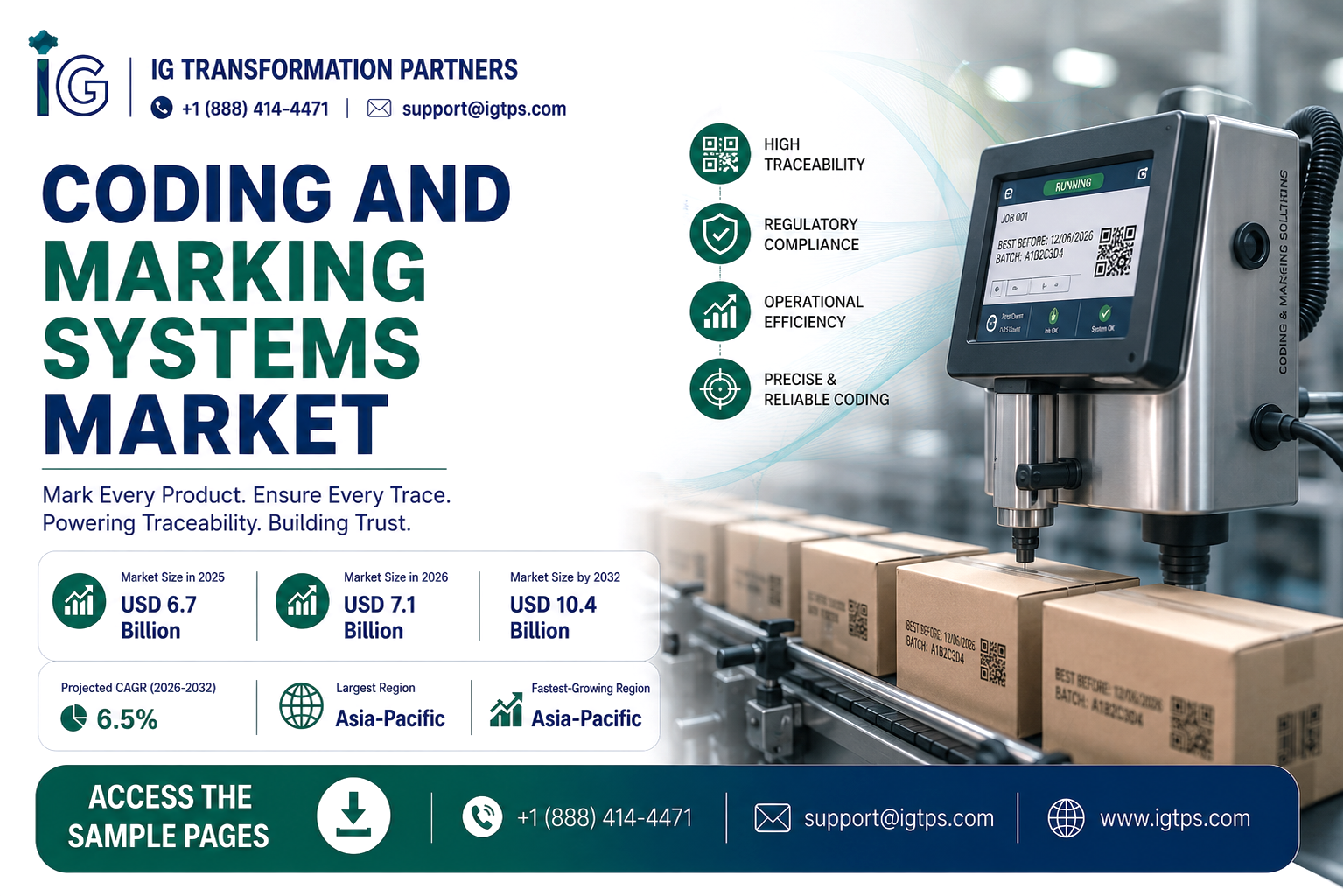
The global Coding and Marking Systems Market is entering a period of steady expansion, driven by increasing demand for product traceability, regulatory compliance, brand protection, and efficient packaging operations across industries. As manufacturers continue to adopt automated production lines and smart packaging solutions, advanced coding and marking technologies are becoming essential components of modern manufacturing.
The Coding and Marking Systems Market was valued at USD 6.7 billion in 2025 and is projected to reach USD 7.1 billion in 2026. The market is expected to grow to USD 10.4 billion by 2032, registering a CAGR of 6.5% during 2026–2032.
Rising Demand for Product Identification and Traceability
One of the major factors supporting the growth of the Coding and Marking Systems Market is the increasing need for accurate product identification and traceability. Manufacturers across food and beverage, pharmaceuticals, automotive, electronics, chemicals, and consumer goods rely on coding and marking solutions to print essential information such as batch numbers, manufacturing dates, expiration dates, barcodes, QR codes, and serial numbers.
As global supply chains become more complex, businesses are placing greater emphasis on tracking products throughout manufacturing, distribution, and retail processes. This trend is creating new opportunities for industrial coding and marking systems that can deliver high-speed, reliable, and accurate printing.
Technology Advancements Transforming the Market
The market includes several technologies designed to meet the diverse requirements of modern production environments. Continuous Inkjet (CIJ) remains an important technology for high-speed, non-contact printing on products and packaging. It is widely used in industries where production lines operate continuously.
Thermal Inkjet (TIJ) technology is also gaining attention due to its ability to produce high-resolution codes and graphics. Meanwhile, laser coding and marking systems are increasingly preferred for permanent, contactless marking and applications requiring high durability.
Other technologies, including Thermal Transfer Overprinting (TTO), Drop-on-Demand (DOD) Inkjet, Print & Apply Labeling, and Hot Stamping, provide manufacturers with flexible solutions for different packaging materials and production requirements.
Automation and Smart Manufacturing Create New Opportunities
The growing adoption of automation is another important driver for the coding and marking market. Manufacturers are increasingly integrating coding equipment with automated packaging lines, manufacturing execution systems, and enterprise software platforms.
The integration of coding and marking equipment with digital production systems allows companies to improve operational efficiency, minimize human errors, and maintain consistent product identification. Advanced software and connected services can also support real-time monitoring, remote diagnostics, and predictive maintenance.
As Industry 4.0 adoption accelerates, demand for intelligent and connected packaging coding systems is expected to increase across manufacturing sectors.
Food and Beverage and Pharmaceutical Industries Drive Demand
The food and beverage industry represents a significant application area for product coding and marking solutions. Manufacturers require reliable systems to print expiration dates, batch information, barcodes, and traceability codes on primary and secondary packaging.
The pharmaceutical industry is another major contributor to market growth. Strict regulations surrounding product authentication and traceability have increased the need for accurate serialization and identification solutions. As pharmaceutical manufacturers expand production and adopt advanced packaging technologies, demand for reliable marking systems is expected to remain strong.
Other industries, including automotive, electrical and electronics, chemicals, cosmetics and personal care, building materials, logistics and warehousing, and tobacco, also rely on coding and marking technologies to support identification and supply chain management.
Asia-Pacific Leads the Global Market
Asia-Pacific is currently the largest region in the Coding and Marking Systems Market and is also projected to be the fastest-growing region through 2032. Rapid industrialization, expanding manufacturing activities, increasing investments in packaging infrastructure, and growing exports are supporting regional market growth.
Countries across the region are witnessing increasing demand for automated production and packaging systems. The expansion of food processing, pharmaceutical manufacturing, consumer goods, electronics, and logistics industries is further strengthening the adoption of industrial marking solutions.
The increasing focus on product safety, regulatory compliance, and supply chain traceability is also encouraging manufacturers in Asia-Pacific to invest in advanced coding technologies.
Competitive Landscape and Market Outlook
The Coding and Marking Systems Market includes equipment, consumables, software, and services, allowing vendors to develop comprehensive solutions for manufacturers. Companies are focusing on product innovation, automation, improved printing quality, sustainability, and connected technologies to strengthen their market position.
The growing demand for efficient production processes and accurate product identification is expected to create attractive opportunities for technology providers. Manufacturers that can deliver flexible, reliable, and cost-effective solutions are likely to benefit from the expanding demand across multiple end-use industries.
Conclusion
The global Coding and Marking Systems Market is expected to maintain steady growth as industries increasingly prioritize traceability, automation, regulatory compliance, and efficient packaging operations. With the market projected to increase from USD 7.1 billion in 2026 to USD 10.4 billion by 2032, opportunities are emerging across technologies, packaging formats, materials, and end-use industries.
Asia-Pacific is expected to remain at the forefront of market development, supported by rapid industrialization and expanding manufacturing capabilities. At the same time, innovations in laser marking, inkjet printing, software integration, and smart manufacturing are likely to shape the future of the industry.
Read the sample pages here to explore detailed insights, market trends, segmentation, regional analysis, competitive developments, and forecasts for the Coding and Marking Systems Market through 2032.

 COMMENT
 FACBOOK


Comments (0)